Nyungwe Forest National Park
Nyungwe Forest National Park protects one of Africa’s oldest rainforests, a vast high-altitude ecosystem holding thirteen primate species, over three hundred bird species, and the only canopy walkway in Rwanda, a suspended bridge strung nearly fifty metres above the forest floor. For travellers with a real interest in primates or birding beyond gorillas alone, Nyungwe frequently becomes the trip’s most memorable stop rather than an afterthought.
What makes Nyungwe distinct from Uganda’s rainforest parks is scale and altitude. This is high montane forest, cooler and mistier than Kibale or Bwindi, spread across three distinct access sectors, Uwinka, Gisakura, and Kitabi, each offering a genuinely different mix of activities. Understanding which sector suits your specific interests, chimpanzee trekking, canopy walking, or waterfall hiking, shapes how satisfying a Nyungwe visit turns out to be.
Should You Visit Nyungwe Forest National Park?
Nyungwe suits travellers with a genuine interest in primates and birdlife beyond gorillas alone, and those willing to add a rainforest leg to an itinerary otherwise built around Volcanoes National Park: chimpanzee trekking here, while excellent, does not match Uganda’s Kibale for sheer sighting reliability, since Nyungwe’s habituated troops range across a genuinely vast forest area. What Nyungwe offers instead is unmatched breadth, thirteen primate species, the canopy walk, and considerably stronger birding than either of Rwanda’s other major parks.
The honest trade-off is distance. Nyungwe sits in Rwanda’s remote southwest, a four to five hour drive from Kigali and a similar distance from Volcanoes National Park, making it a genuine commitment rather than a quick add-on. Travellers with limited time sometimes skip it in favour of concentrating fully on gorilla trekking; those with a week or more in Rwanda, or a specific interest in chimpanzees and forest birding, find the additional transfer time well rewarded.
Nyungwe also plays a specific practical role for travellers chasing Rwanda’s low-season gorilla permit discount, since qualifying for the 30% reduction requires genuine time spent at both Nyungwe and Akagera, not simply Volcanoes National Park alone. For budget-conscious travellers visiting in the November to May window, Nyungwe becomes less an optional extra and more a functional part of qualifying for meaningful savings elsewhere in the trip.
Why Nyungwe Matters
One of Africa’s Oldest Rainforests
Nyungwe’s montane forest is believed to have survived largely intact through the ice ages that reshaped much of the continent’s vegetation, making it one of the oldest and most biodiverse rainforest ecosystems in Africa. That age and stability show up directly in its species list: thirteen primate species, including chimpanzee, several colobus species, and Rwenzori Angolan colobus troops that can run into the hundreds of individuals, a genuinely striking sight when encountered on a forest trail.
The Canopy Walk
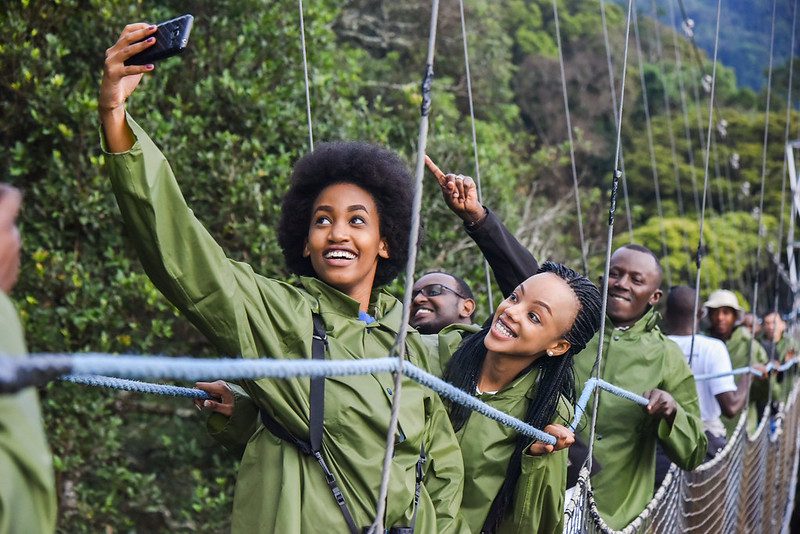
Rwanda’s only canopy walkway, a suspended steel bridge strung across three towers nearly fifty metres above the forest floor, offers a genuinely different vantage point on the rainforest than a ground-level walk provides, looking directly into the upper canopy where much of the forest’s bird and primate activity actually occurs. The walk is open to visitors aged six and above, making it one of the more family-friendly headline activities in the park.

Chimpanzee Trekking Across Three Sectors
Nyungwe offers chimpanzee trekking from its Uwinka and Gisakura sectors, with treks running up to four hours and a maximum group size of eight visitors, considerably smaller than some alternative sites. Success rates are good but not as consistently high as Uganda’s Kibale, given the sheer scale of forest the chimpanzees range across, a trade-off we discuss honestly with every client considering Nyungwe specifically for chimps.
Serious Birding Territory
With over three hundred recorded bird species, including a strong list of Albertine Rift endemics, Nyungwe stands as one of the premier birding destinations in East Africa, a genuine draw for travellers whose interest in Rwanda extends well beyond primates alone.
A Living Research Landscape
Nyungwe has hosted continuous primate and ecological research for decades, and several of its habituated chimpanzee troops are studied by resident researchers whose work directly informs the park’s tracking and conservation strategies. This research presence gives guides at Nyungwe an unusually deep well of knowledge to draw on during a trek, often pointing out behavioural details, feeding patterns, or inter-troop dynamics that go well beyond a standard wildlife sighting.
Where Nyungwe Fits on a Rwanda Itinerary
Nyungwe sits in Rwanda’s remote southwest, near the town of Cyangugu and Lake Kivu’s southern shore, roughly four to five hours by road from Kigali and a similar distance from Volcanoes National Park. Its position makes it a natural extension of a Rwanda circuit that also includes Lake Kivu, rather than a convenient stopover on the way to anywhere else.
| From | Approx. Distance / Time | Notes |
| Kigali International Airport | 4 – 5 hours by road | Domestic flights to Kamembe airstrip cut this considerably for time-limited travellers. |
| Volcanoes National Park | 4 – 5 hours by road | The standard pairing for a combined gorilla and chimpanzee circuit. |
| Lake Kivu (southern shore) | 1 – 1.5 hours | A natural, relaxed extension after forest activities. |
| Akagera National Park | 6 – 7 hours by road | Best linked via Kigali rather than a direct cross-country route. |
When to Visit
| Season | Months | What to Expect |
| Dry Season | June – September, December – February | Firmer forest trails, the most comfortable window for chimpanzee trekking and the canopy walk. |
| Wet Season | March – May, October – November | Higher rainfall typical of montane rainforest, muddier trails, though sightings and birding remain strong. |
As genuine rainforest, Nyungwe receives meaningful rainfall in every month of the year, so travellers should not expect a fully dry visit even during the nominal dry season. Chimpanzee tracking success is not strongly seasonal here, since trackers follow known movement patterns regardless of rainfall, though trail comfort improves considerably during the drier windows.
Tea Estates at the Forest Edge
Nyungwe’s boundary is ringed by working tea plantations, a striking visual contrast between cultivated green terraces and dense, dark rainforest that makes the drive into the park itself part of the experience. Several lodges, including the park’s flagship luxury property, are built directly among these estates, and a short tea factory visit is a worthwhile, low-effort addition for travellers with a spare hour between forest activities.
Budgeting for Nyungwe
Nyungwe’s costs sit well below Volcanoes National Park’s gorilla permit. Chimpanzee trekking runs around 250 US dollars per person, and the canopy walk costs around 60 US dollars, both considerably more accessible than gorilla trekking’s 1,500 US dollar fee. Park entry fees apply separately for general forest walks and waterfall hikes.
| Tier | Approx. Cost (per person/night, full board) | What You Get |
| Budget | US$70 – 150 | Simple guesthouses near Gisakura or Kitabi, basic but functional facilities. |
| Mid-Range | US$180 – 320 | Established lodges with en-suite rooms and easy access to the park’s main trailheads. |
| Luxury | US$400 – 750+ | Higher-end lodges with forest or Lake Kivu views and more personalised guiding. |
Given Nyungwe’s considerably lower activity costs relative to gorilla trekking, we often suggest allocating a comfortable mid-range stay here, reserving the largest share of the accommodation budget for Volcanoes National Park, where the single most expensive activity of the trip takes place.
Where to Stay
- One&Only Nyungwe House, a genuine luxury standout set among tea plantations at the forest’s edge, offering some of the most distinctive accommodation in the park.
- Nyungwe Top View Hill Hotel and similar mid-range properties near Gisakura, offering solid comfort and straightforward trailhead access.
- Simple guesthouses near Kitabi and Cyangugu for budget-conscious travellers, particularly useful for those combining Nyungwe with Lake Kivu.
Activities Inside the Park
- Chimpanzee trekking from the Uwinka or Gisakura sectors, up to four hours, with a maximum group size of eight visitors.
- The canopy walk, a suspended bridge nearly fifty metres above the forest floor, open to visitors aged six and above.
- Guided forest walks and waterfall hikes across a network of trails radiating from the Uwinka visitor centre.
- Colobus monkey tracking, offering a chance to see troops of Rwenzori Angolan colobus that can number in the hundreds.
- Birding walks focused on the park’s strong list of Albertine Rift endemic species.
Planning Advice
- Book chimpanzee trekking permits a few weeks ahead for peak season travel; availability is generally more forgiving than gorilla permits but should not be left to the last minute.
- Combine the canopy walk with a chimpanzee trek or forest walk on the same day where possible, since both are commonly based from the Uwinka visitor centre.
- If chasing Rwanda’s low-season gorilla permit discount, plan a genuine multi-night Nyungwe stay rather than a token stop, since authorities verify real multi-park engagement.
- Pack proper rain gear regardless of season, since Nyungwe’s montane rainforest receives meaningful rainfall throughout the year.
- Consider a domestic flight to Kamembe airstrip if time is limited, given the considerable road distance from Kigali.
Who Nyungwe Suits Best
| Traveller Type | Recommendation |
| Primate enthusiast wanting variety beyond gorillas | Excellent fit given thirteen primate species and strong colobus tracking. |
| Birder | Outstanding candidate given the park’s extensive Albertine Rift endemic species list. |
| Traveller chasing the low-season gorilla permit discount | Should plan genuine time at Nyungwe specifically to qualify for the reduced rate. |
| Traveller with limited time in Rwanda | May reasonably prioritise Volcanoes National Park alone given Nyungwe’s considerable distance. |
| Family with children | The canopy walk, open to ages six and up, is a strong, memorable, family-friendly activity. |
| Traveller combining with Lake Kivu | Ideal pairing, given Nyungwe’s proximity to the lake’s southern shore. |
Frequently Asked Questions
How does Nyungwe’s chimpanzee trekking compare to Uganda’s Kibale?
Kibale generally offers a higher sighting success rate, given its longer habituation history and more concentrated tracking area. Nyungwe’s considerably larger forest means chimpanzees range more widely, making success rates good but somewhat less consistent.
Is the canopy walk safe?
Yes, the walkway is a well-maintained, professionally engineered structure open to visitors aged six and above, with safety harnessing and guide supervision throughout.
How far is Nyungwe from Volcanoes National Park?
Roughly four to five hours by road, making it a genuine multi-day commitment rather than a quick stopover, best suited to travellers with a week or more in Rwanda.
Do I need the low-season gorilla permit discount to justify visiting Nyungwe?
No, Nyungwe is worth visiting on its own merits given its primate diversity, birding, and canopy walk. The permit discount is simply an added financial incentive for travellers already planning a genuine multi-park circuit.
What is the best time of year for chimpanzee trekking at Nyungwe?
June to September and December to February offer the firmest trails, though tracking success is not strongly seasonal, since chimpanzee movement patterns are followed year-round regardless of rainfall.
Can I combine Nyungwe with Lake Kivu?
Yes, easily. The lake’s southern shore sits roughly an hour to ninety minutes from the park, making it a natural, relaxed extension after forest-based activities, and many travellers use a Lake Kivu stay specifically to unwind after the physical demands of chimpanzee trekking or the canopy walk.