Kibale Forest National Park
Kibale forest national park holds one of the highest densities of primates anywhere in Africa, thirteen species in total, and its habituated chimpanzee communities are tracked with a success rate that consistently outperforms every other chimp-tracking site in Uganda, including Kyambura Gorge and Budongo Forest.
What makes Kibale an easy recommendation is how little qualification it needs. Unlike Mgahinga’s uncertain gorilla availability or Ishasha’s unpredictable tree-climbing lions, Kibale’s core promise, a strong chance of extended, close chimpanzee viewing, is one we can make to clients with genuine confidence.
The forest’s proximity to Fort Portal and its position on the route between Queen Elizabeth and Murchison Falls only add to its case as one of the more straightforward inclusions on a Uganda itinerary.
Should You Visit Kibale?
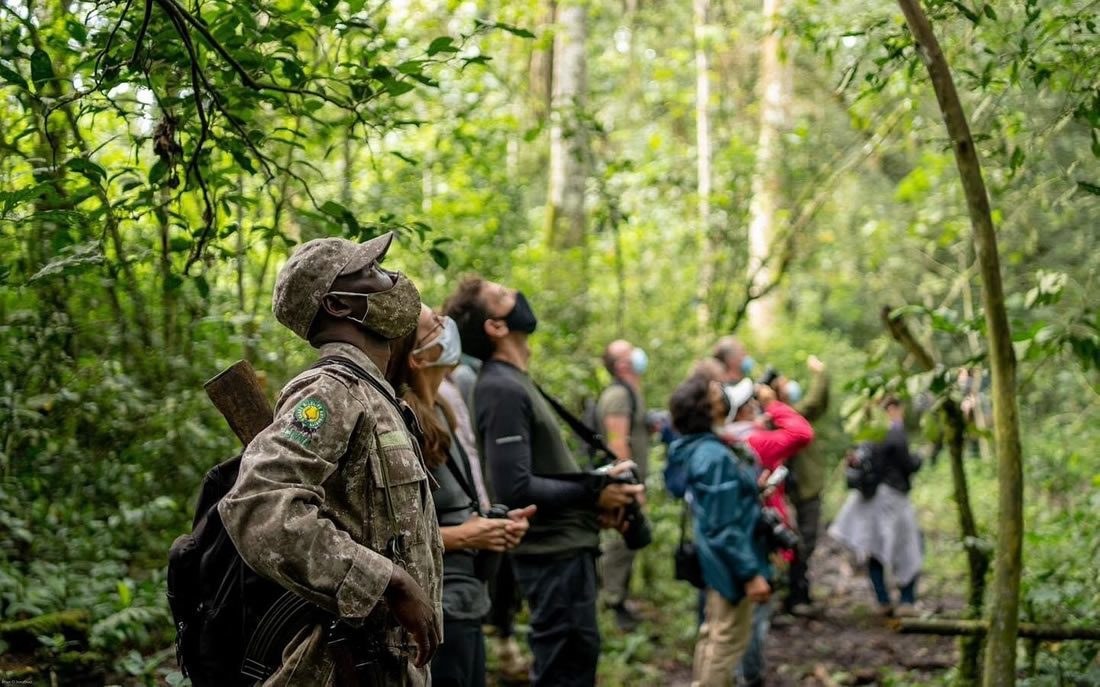
Kibale suits nearly every traveller with an interest in primates, and asks relatively little in return: the standard chimpanzee trek runs two to three hours, involves moderate rather than strenuous walking, and delivers sightings at a consistently high success rate. Travellers who have found gorilla permits too expensive, too physically demanding, or simply unavailable for their dates often find Kibale’s chimpanzee tracking a genuinely satisfying substitute rather than a consolation choice.
The one honest caveat concerns expectation-setting around behaviour. Chimpanzees move quickly and unpredictably through the canopy and understory, and while sightings are highly likely, the encounter feels different from a gorilla trek’s calmer, ground-level family scene. Guides here work hard to position groups for good views, but travellers expecting the same static, close-range experience as gorilla trekking should adjust that expectation slightly before setting out.
For families and travellers with moderate fitness levels, Kibale is one of the more accessible primate experiences in Uganda, requiring less physical exertion than most Bwindi sectors and none of Rushaga’s steep terrain. That accessibility, combined with the strength of the sighting rates, is why we include Kibale in the large majority of itineraries that also feature Queen Elizabeth or Murchison Falls.
Reasons for Visiting Kibale National Park
The Highest Chimpanzee Tracking Success Rate in Uganda
Kibale’s habituated chimpanzee communities, tracked daily by experienced Uganda Wildlife Authority guides, deliver sighting rates well above ninety percent, a figure meaningfully higher than Kyambura Gorge’s smaller, more dispersed community or Budongo Forest’s more recently habituated groups. For travellers whose primary interest is a reliable chimpanzee encounter rather than a broader forest experience, this success rate alone makes a strong case for Kibale over its alternatives.
Thirteen Primate Species in One Forest
Beyond chimpanzees, Kibale’s roughly 795 square kilometres of rainforest support red colobus, black-and-white colobus, grey-cheeked mangabey, L’Hoest’s monkey, and blue monkey, among others, giving the forest one of the highest primate densities recorded anywhere on the continent. Travellers extending beyond the standard chimp trek often add a guided forest walk specifically to work through this wider primate list.
The Chimpanzee Habituation Experience
For travellers wanting more than the standard two to three hour trek, Kibale offers a full-day habituation experience, following researchers and trackers as they follow a community from dawn nesting sites through the day’s foraging and social behaviour. This extended format offers a considerably deeper look at chimpanzee behaviour than the standard trek, at additional cost and physical commitment.
Bigodi Wetland Sanctuary, a Strong Complement
Just outside the park, the community-run Bigodi Wetland Sanctuary offers a guided walk through swamp forest without a park permit requirement, turning up strong birding, including hornbills and the elusive great blue turaco, alongside several primate species. It is a popular, low-cost addition for travellers with a spare half-day around their Kibale trek.
A Base Also Worth Exploring: Fort Portal and Its Crater Lakes
Kibale’s proximity to Fort Portal means most itineraries built around the park also brush against the wider Fort Portal region, dotted with volcanic crater lakes, rolling tea plantations, and the striking Rwenzori foothills in the near distance. Travellers with a spare half-day sometimes add a crater lake walk or a tea estate visit around their chimpanzee trek, and several of the region’s stronger lodges, Kyaninga Lodge among them, are built directly into this crater lake scenery rather than at the forest edge itself. We mention this because Kibale rarely needs to be treated as an isolated stop bookended by long transfers; the surrounding region offers enough to fill an extra day comfortably for travellers not in a rush to move on.
Where Kibale Fits on a Uganda Itinerary
Kibale sits just outside Fort Portal, a well-connected town in western Uganda, roughly four to five hours by road from Kampala or a shorter domestic flight to Kasese followed by a road transfer. Its location between Queen Elizabeth National Park, roughly two to three hours south, and the broader western circuit toward Bwindi makes it easy to combine with a wider itinerary rather than requiring a dedicated detour.
| From | Approx. Distance / Time | Notes |
| Kampala / Entebbe (road) | 4 – 5 hours | Direct route via Mubende; well-maintained tarmac for most of the journey. |
| Kasese Airstrip (air, then road) | About 1 hour flight, then 1.5 hours by road | A faster alternative for time-limited itineraries. |
| Queen Elizabeth National Park | 2 – 3 hours | Natural link for a combined chimp-tracking and savannah circuit. |
| Semliki National Park | 2 – 3 hours | Combinable for travellers extending into western Uganda’s rainforest parks. |
When to Visit
| Season | Months | What to Expect |
| Dry Season | June – August, December – February | Firmer forest trails, the most popular trekking months. |
| Wet Season | March – May, September – November | Muddier trails and higher rainfall, but chimpanzee sightings remain reliable year-round since tracking does not depend on dry conditions. |
Unlike savannah game viewing, chimpanzee tracking success at Kibale is not strongly seasonal, since trackers follow known nesting and feeding patterns regardless of rainfall. We therefore let overall itinerary logistics, rather than Kibale-specific timing, determine when to schedule this stop.
Budgeting for Kibale
Kibale’s chimpanzee trekking permit is priced well below a Bwindi gorilla permit, generally in the range of 200 US dollars per person for the standard trek, with the full-day habituation experience priced higher, though still considerably less than gorilla habituation. Park entry fees and the Bigodi Wetland Sanctuary walk are separate, modest add-ons.
| Tier | Approx. Cost (per person/night, full board) | What You Get |
| Budget | US$60 – 140 | Simple guesthouses in Fort Portal or community-run accommodation near the park boundary. |
| Mid-Range | US$180 – 320 | Established forest lodges with en-suite rooms and easy access to the trailhead. |
| Luxury | US$400 – 700+ | Higher-end forest lodges with elevated design and more personalised trekking arrangements. |
Given the moderate cost of the permit relative to gorilla trekking, Kibale is one of the more budget-friendly primate experiences on a Uganda itinerary, making it easy to combine strong wildlife viewing with a mid-range accommodation choice without straining the overall trip budget.
Where to Stay
- Primate Lodge Kibale, positioned inside the park itself, the most convenient base for early morning trekking departures.
- Kyaninga Lodge, a striking upper-range property near Fort Portal, known for its crater lake setting and architecture.
- A range of mid-range and budget guesthouses in and around Fort Portal town, offering flexibility for travellers combining Kibale with wider regional exploration.
Activities to do in the Park
- The standard chimpanzee trek, two to three hours, departing early morning from the park’s Kanyanchu visitor centre.
- The full-day chimpanzee habituation experience, following a community from dawn through a complete day’s activity.
- Guided forest walks focused on the park’s wider primate list, including red colobus and L’Hoest’s monkey.
- The Bigodi Wetland Sanctuary walk, just outside the park, for birding and primates without a park permit requirement.
- Night walks in select areas for nocturnal species such as bushbabies and pottos, offered by some lodges.
Travellers with an extra half-day sometimes add a guided nature walk through the crater lake region near Fort Portal, a gentle, scenic complement to the forest trekking that requires no permit and pairs naturally with a lunch stop at one of the area’s lakeside lodges.
Planning Advice
- Book chimpanzee trekking permits at least a few weeks ahead for peak dry-season travel; availability is generally more forgiving than Bwindi’s gorilla permits but should not be left to the last minute.
- Add the Bigodi Wetland Sanctuary walk as a low-cost, high-value half-day addition around your main trekking day.
- Consider the habituation experience if you have a genuine interest in chimpanzee behaviour and are comfortable with a longer, more physically demanding day.
- Combine Kibale with Queen Elizabeth National Park for an efficient western Uganda circuit rather than treating it as a standalone stop.
- Pack for rain regardless of season, since Kibale is genuine rainforest and weather can shift quickly even in the drier months.
Who Kibale Suits Best
| Traveller Type | Recommendation |
| Primate enthusiast prioritising chimpanzees | Excellent, close to unmatched fit given Uganda’s highest chimp-tracking success rate. |
| Family or traveller wanting a moderate trek | Well suited given the standard trek’s manageable length and terrain compared to gorilla trekking. |
| Traveller who could not secure a gorilla permit | Strong alternative offering a genuinely rewarding primate encounter at lower cost. |
| Serious birder | Rewarding when combined with the Bigodi Wetland Sanctuary walk just outside the park. |
| Traveller wanting deep behavioural insight | Should consider the full-day habituation experience over the standard trek. |
| Combined Uganda circuit traveller | Fits naturally between Queen Elizabeth and the wider western Uganda route. |
Frequently Asked Questions
How does Kibale compare to Kyambura Gorge or Budongo Forest for chimp tracking?
Kibale offers a meaningfully higher sighting success rate than either alternative, owing to its larger habituated communities and longer tracking history. Kyambura Gorge and Budongo remain worthwhile if you are not visiting Kibale on the same trip, but neither matches Kibale’s reliability.
How physically demanding is chimpanzee trekking at Kibale?
Moderate. The standard trek runs two to three hours over generally manageable forest terrain, considerably less demanding than most Bwindi gorilla trekking sectors.
What is the chimpanzee habituation experience?
A full-day activity following a community from dawn nesting sites through the day’s foraging and social behaviour, offering a deeper look at chimpanzee life than the standard trek, at higher cost and with a longer physical commitment.
Is Kibale suitable for children?
The Uganda Wildlife Authority sets a minimum age for chimpanzee trekking, generally around twelve, though this should be confirmed directly with your operator, since age policies can be updated.
What else can I do near Kibale besides chimp trekking?
The Bigodi Wetland Sanctuary, a community-run reserve just outside the park, offers strong birding and primate viewing without requiring a park permit, and is a popular half-day addition.
How do I combine Kibale national park with the rest of my Uganda itinerary?
It links most naturally with Queen Elizabeth National Park, two to three hours south, and can also be combined with Semliki National Park for travellers extending further into western Uganda’s rainforest parks.
What should I pack for chimpanzee trekking at Kibale National Park?
Sturdy, closed walking shoes, a light rain jacket regardless of season, and gardening-style gloves for pushing through undergrowth are the essentials. Because the forest floor can be damp even in drier months, we also recommend long trousers over shorts, both for comfort against vegetation and as a simple precaution against biting insects.